Vietnam's exports grew 15% last year. Logistics hasn't kept up. That gap — between how fast Vietnamese sellers are growing and how reliably their shipments move — is the real story of cross-border e-commerce in 2026. Sellers are winning on price, product, and marketplace reach. But the moment a parcel crosses the border, much of that advantage gets eroded: by customs holds, invisible shipments, unpredictable fees, and a carrier market too fragmented to navigate without a full-time logistics team.
This isn't a complaint. It's a diagnosis. And understanding exactly where the system breaks is the first step to shipping better.
Vietnam's Export Boom Isn't the Problem. Logistics Is.
The numbers are hard to argue with. Vietnam's total exports reached approximately $475 billion in 2025 — up 17% year-on-year — with shipments to the United States alone jumping 28%, hitting $153.2 billion. For the third consecutive year, Vietnam outpaced regional peers as a manufacturing and export hub for global e-commerce.But behind the headline growth sits a less comfortable truth: Vietnam's logistics costs account for roughly 16.5% of GDP, compared to a global average of 11.6%. Sellers are paying a logistics premium that eats directly into margins — not because they're shipping wrong, but because the infrastructure around them hasn't scaled at the same speed their businesses have.The four fault lines show up again and again.Customs Delays That Swallow Days — and Deals
Customs clearance is the most predictable bottleneck in Vietnamese cross-border shipping — and yet it still catches sellers off guard.Documentation errors are the leading cause of holds. A misclassified HS code, an incomplete commercial invoice, or a mismatch between declared value and actual shipment content is enough to pause a consignment fordays. Vietnam tightened its customs regime further in early 2026, making declaration mandatory for every outbound package regardless of value — a compliance shift that caught many small exporters unprepared.The downstream effects aren't just operational. Delayed customs clearance means delayed delivery windows promised to buyers on Amazon, Shopee, or eBay. Miss enough delivery estimates and your seller rating suffers. Miss enough seller ratings and your marketplace visibility drops. A documentation error at origin can cost a seller their ranking — not just their shipment.A Carrier Landscape Too Fragmented to Trust
Vietnam has no shortage of carriers. The problem is the opposite: there are too many, each with narrow lane coverage, inconsistent service levels, and opaque rate structures.Approximately84% of road freight in Vietnam is operated by owner-operators with fleets of fewer than ten vehicles. That structural fragmentation means sellers are often stitching together multiple carriers to cover a single end-to-end lane — and absorbing the coordination risk that comes with it. A shipment from a factory in Binh Duong to a warehouse in Los Angeles might touch four to five handoff points, with no single party accountable for the full journey.For sellers with volume, this isn't sustainable. For sellers just starting to scale, it's paralyzing.
Your Shipment Is Somewhere. You Just Don't Know Where.
Tracking anxiety is real — and it's not just a feeling. Most Vietnam-origin shipments travel through carrier networks that update tracking milestones infrequently, use inconsistent status language across handoffs, and provide no proactive alerts when a delay occurs.The seller finds out something is wrong when the buyer asks. The buyer asks when their expected delivery window has passed. By then, the issue has already affected the purchase experience — and potentially the review.Real-time, end-to-end visibility isn't a luxury for modern cross-border shipping. It's abaseline expectation. Most of the current logistics stack in Vietnam still doesn't meet it.Pricing Is Still a Guessing Game
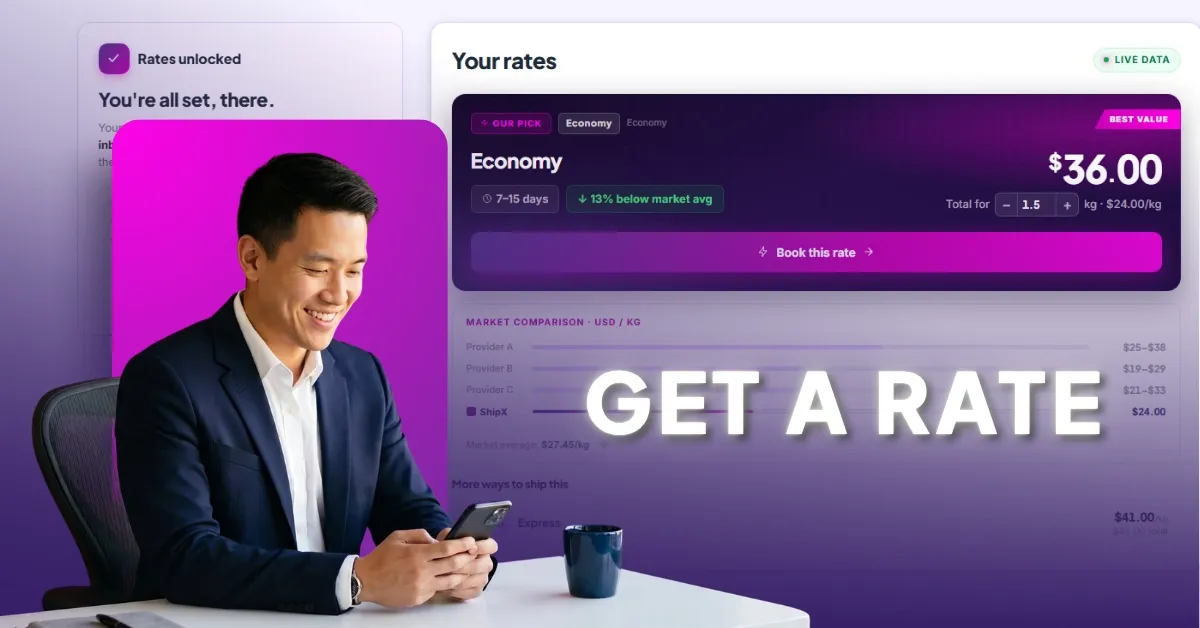
Ask a Vietnam-based seller what it costs to ship a 2kg parcel to a consumer in Texas, and most will give you a range — not a number. That range is the problem.Freight rates fluctuate with carrier capacity, fuel surcharges, peak season premiums, and currency swings. Without a system that compares rates across carriers and lanes in real time, sellers default to manual quote requests: email, WhatsApp, or a spreadsheet built six months ago. Pricing decisions that should take seconds take hours. And because the comparison is manual, sellers rarely know if they're getting the best available rate — or just a familiar one.Manual pricing doesn't just waste time. It locks sellers into relationships they can't benchmark.Something Better Is Coming
The problems above are structural, but they're not permanent. Technology has already solved harder coordination problems in adjacent industries. The same AI-enabled approach — connecting fragmented supply, applying intelligent routing, and surfacing real-time data to the seller — is entirely applicable to cross-border logistics in Southeast Asia.ShipX is building exactly that. An AI- and technology-enabled aggregator platform that connects45+ carriersacross200+ destinations, handles customs documentation end-to-end, and gives sellers real-time shipment visibility from first-mile pickup to last-mile delivery.| Stay tuned — a better way is coming.2,500+ active clients · 2.5M+ orders processed · 45+ carrier partners · 200+ countries |

Frequently Asked Questions
Why is Vietnam cross-border shipping so expensive compared to other countries?
Vietnam's logistics costs represent approximately 16.5% of GDP — well above the global average of 11.6%. This reflects a combination of fragmented road freight infrastructure, high customs compliance overhead, and limited consolidation technology that forces sellers to pay market rates without the buying power of volume.What causes customs delays in Vietnam cross-border shipments?
The most common causes are documentation errors — incorrect HS codes, mismatched declared values, or incomplete commercial invoices. Vietnam's 2026 customs reforms made declaration mandatory for all outbound packages, increasing the compliance burden for exporters who previously operated below declaration thresholds.How do I get real-time tracking on shipments from Vietnam?
Real-time tracking depends on the carrier and the logistics platform you're using. Platforms that aggregate multiple carriers into a single interface — like ShipX — can provide unified tracking across the full journey, regardless of how many carriers handle the shipment.What are the most reliable carriers for shipping from Vietnam to the US?
Reliability varies by product type, volume, and transit time requirement. Global express carriers (DHL, FedEx, UPS) offer the fastest and most trackable service but at a premium. Postal and economy options offer lower rates with longer transit times. An aggregator platform can match the right carrier to your specific shipment profile.Is Vietnam cross-border shipping expected to improve?
Yes — Vietnam's government approved a National Logistics Strategy in October 2025 targeting a globally competitive logistics sector by 2035, including infrastructure investment and regulatory streamlining. Technology-enabled platforms are also driving improvement faster than infrastructure alone can.About ShipXShipX is an all-in-one cross-border logistics platform for businesses in Southeast Asia. It handles every step from first-mile pickup to last-mile global delivery across 200+ destinations.shipx.asia 


 SGLINK